
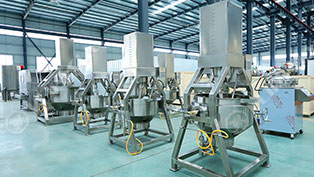

When selecting a steam autoclave, many food processing companies focus primarily on the price of the equipment but tend to overlook a more critical issue: what capacity is actually needed? A capacity that is too small will increase the number of batches, affecting production efficiency; conversely, simply pursuing a larger machine may result in inefficient loading. Therefore, the correct capacity should be determined by comprehensively considering the product type, packaging specifications, load per batch, and production cycle.
How Should Steam Autoclave Capacity Be Calculated?
Determine How Much Product Needs to Be Processed Daily
Steam autoclave selection should not be based solely on theoretical daily output. For example, if a factory needs to sterilize a certain quantity of bagged food products daily, it must further determine the actual product load per batch and the duration of each sterilization cycle.
In addition to the sterilization and holding phases, heating, cooling, loading, and unloading times must also be considered. Therefore, the equipment's actual production capacity is not entirely equivalent to the simple tank volume.

Packaging Size Also Affects Equipment Capacity
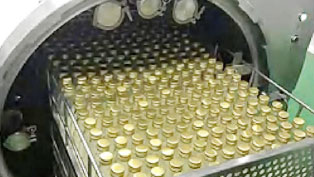
Even with the same equipment volume, the number of products that can be loaded varies depending on the packaging method. Packaging types such as retort pouches, glass jars, and metal cans differ in terms of arrangement, spacing, and loading density.
For bagged or canned foods, a well-designed internal loading structure ensures that products are fully exposed to circulating hot water and spray media, helping to maintain a more stable heat distribution.
What Should Be Considered When Selecting Capacity?
The core function of a steam autoclave is not simply to place products into a heated chamber, but to achieve stable temperature control and uniform heat transfer throughout the entire sterilization process.
LONKIA's water bath + full-spray structure ensures that the circulating medium covers the product surface, enabling heat treatment in a stable temperature environment. The steam autoclave's temperature range is adjustable from 60–121°C, and its capacity and dimensions can be customized according to the customer's production requirements.
Therefore, when selecting a steam autoclave, you should consider the following factors:
- The quantity of product to be processed per batch
- Product packaging dimensions and arrangement
- The number of batches to be completed daily
- Target sterilization temperature and duration
- Available installation space at the facility
- Upstream and downstream equipment on the existing production line

How to Determine the Right Steam Autoclave for Your Needs?
Provide Actual Production Data
When requesting a quote from equipment suppliers, it is recommended to provide the product name, weight per bag/can, package dimensions, daily output, planned number of batches, and target sterilization temperature in advance.
Design Based on Actual Load Capacity
The equipment capacity must match the actual load capacity. LONKIA can provide customized capacities and equipment dimensions based on product packaging formats and production requirements, and configure corresponding control systems to allow operators to monitor and adjust sterilization parameters.
For Which Foods Is a Steam Autoclave Suitable?
This type of steam autoclave is used for high-temperature processing of canned foods, sauces, condiments, beverages, and prepackaged foods. It is particularly suitable for production projects that require batch-based heat treatment to enhance food safety and shelf stability.
If you are planning a new food production line, we recommend that you do not select a steam autoclave based solely on the equipment name or price. Instead, you should first determine the product, packaging, batch load capacity, and sterilization process. LONKIA can use these production parameters to further match equipment capacity, dimensions, and configuration, helping customers select sterilization equipment that is better suited to their actual production lines.