
Selecting the right jacketed kettle for your food production operation can significantly impact cooking efficiency, product quality, energy costs, and long-term reliability. Two of the most common heating methods for industrial jacketed kettles are steam and gas. While both are widely used in commercial kitchens, food factories, and processing plants, each method has distinct advantages — and the choice ultimately depends on your production needs.
In this article, we’ll compare steam vs. gas jacketed kettles and help you determine which one is best for your business.
What Is a Jacketed Kettle?
A jacketed kettle is a large cooking vessel with a double-wall design — the space between the walls (the jacket) is filled with a heating medium (steam or gas-heated thermal fluid). This indirect heating ensures:
even heat distribution
reduced risk of burning or scorching
precise temperature control
consistent product quality
Jacketed kettles are commonly used to cook:
soups and stews
sauces and gravies
jams and purees
dairy products
ready meals
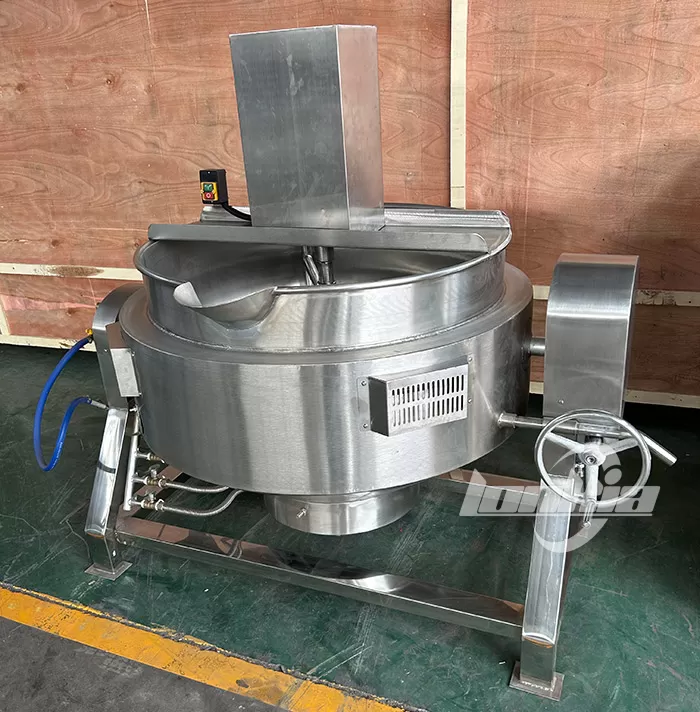
Steam Jacketed Kettles: How They Work
In a steam jacketed kettle, steam generated from a boiler enters the jacket and transfers heat through the kettle walls to the product inside. The steam quickly condenses as it gives up heat, resulting in efficient thermal transfer.
Benefits of Steam Jacketed Kettles
✔ Fast and uniform heating — steam transfers heat more effectively than hot gases, helping cook products evenly and quickly.
✔ Precise temperature control — ideal for batch processes that require strict temperature regulation.
✔ Low product burning risk — gentle indirect heating prevents hotspots.
✔ Integration with existing steam systems — ideal if your facility already has a steam boiler.
Considerations
🔹 Requires a centralized steam boiler system and associated piping.
🔹 Boiler maintenance must be factored into operating costs.
🔹 Best suited where steam infrastructure already exists or when high throughput demands justify the investment.
Gas Jacketed Kettles: How They Work
Gas jacketed kettles heat the jacket using a gas burner (propane or natural gas) that warms thermal fluid or directly heats the jacket space. Heat is then transferred to the cooking vessel.
Benefits of Gas Jacketed Kettles
✔ Lower infrastructure cost — no need for a steam boiler system.
✔ Flexibility — ideal for facilities without existing steam infrastructure.
✔ Rapid temperature changes — gas burners heat up quickly, offering responsiveness.
✔ Good for mid-size operations — effective without the overhead of steam.
Considerations
🔹 Not as even or efficient as steam for very large batch sizes.
🔹 Gas supply and ventilation must be properly managed (safety considerations).
🔹 Slightly higher fuel cost per unit of heat compared to steam, depending on local energy prices.
Steam vs. Gas Jacketed Kettles: Side-by-Side Comparison
| Feature | Steam Jacketed Kettle | Gas Jacketed Kettle |
|---|---|---|
| Heating Efficiency | ⭐⭐⭐⭐ | ⭐⭐⭐ |
| Initial Cost (Equipment Only) | ⭐⭐⭐ | ⭐⭐⭐⭐ |
| Infrastructure Needs | Steam boiler required | Gas supply & ventilation |
| Speed of Heating | ⭐⭐⭐⭐ | ⭐⭐⭐ |
| Temperature Control | ⭐⭐⭐⭐ | ⭐⭐⭐ |
| Suitability for Large Scale | Excellent | Good |
| Operating Cost | Dependent on steam setup | Dependent on gas price |
Which One Is Right for You?
To make the best choice, consider your facility’s infrastructure, production volume, and long-term goals:
Choose a Steam Jacketed Kettle If:
You have an existing steam boiler system.
You need high-throughput production with consistent quality.
You cook heat-sensitive products requiring even, gentle heating.
You aim for precise temperature control.
Choose a Gas Jacketed Kettle If:
Your facility doesn’t have steam infrastructure.
You want a lower upfront setup cost.
You operate at medium scale or batch sizes.
You need faster temperature response without boiler complexity.
Final Thoughts
Both steam and gas jacketed kettles are powerful solutions for industrial cooking — the right one depends on your production scale, energy systems, and budget. Steam models excel in efficiency and control, while gas models offer flexibility and lower initial infrastructure requirements.
If you’re evaluating jacketed kettles for your operation and would like personalized guidance, feel free to contact us with details of your production needs, capacity targets, and facility setup. We’ll help you choose the best solution that optimizes both performance and cost.