

Ready-to-eat foods have high requirements for sterilization effectiveness, packaging integrity, and final product quality. For sealed-packaged cooked foods, prepared meals, meat products, and sauces, selecting the appropriate steam sterilization machine and setting up a reasonable sterilization process based on product characteristics is a critical step for food processing companies to ensure stable production.
Which Ready-to-Eat Foods Can Use a Steam Sterilization Machine?
Steam sterilization machines can be used for the heat treatment of a wide variety of sealed-packaged foods, such as ready-to-eat meals, cooked meat products, soups, and sauces. Specific suitability depends on the food formulation, packaging materials, target sterilization process, and equipment configuration.
For bagged foods, special attention must be paid to the packaging's heat resistance, seal strength, and deformation after heating; for foods packaged in glass jars, factors such as the jar's heat resistance, the heating and cooling process, and changes in internal and external pressure must be considered. Actual product and packaging parameters should be provided prior to purchase to confirm the equipment's suitability.
How to Set the Right Sterilization Parameters?
Higher sterilization temperatures are not necessarily better. The acidity, viscosity, solids content, initial temperature, and packaging thickness of the food all affect heat transfer and microbial control efficacy.
Equipment operation typically involves stages such as heating, holding, and cooling. Operators must determine the parameters for each stage based on validated processes and, in conjunction with product heat penetration tests, confirm that the hardest-to-heat areas inside the packaging meet the specified processing requirements.
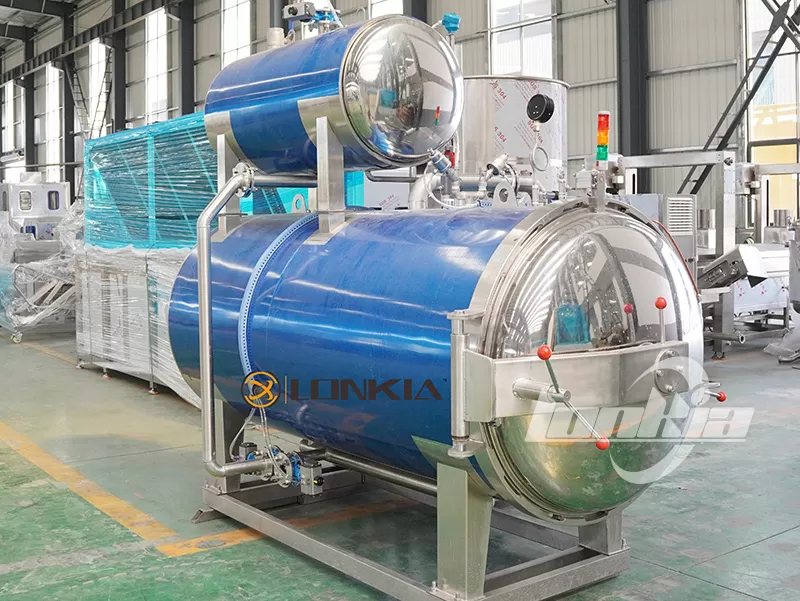
LONKIA's autoclave sterilization machines for pouches and cans feature a design that combines a water bath with spray cooling, with a temperature range of 60–121°C, which can be further confirmed based on specific equipment configurations and product process requirements.
How Does the Machine Help Maintain Product Quality?
During the sterilization process, ready-to-eat foods may experience issues such as texture changes, separation of broth and solids, package swelling, or seal failure. The autoclave sterilization machine's temperature control, hot water circulation, and spray coverage all affect how the product is heated at different locations.
When selecting a steam sterilization machine, focus on confirming the following:
- Temperature Control: Whether the system can monitor and adjust temperature according to the set program.
- Circulation and Spraying: Whether the nozzle layout is suitable for actual loading patterns and whether circulation is stable.
- Pressure Management: Whether it can control relevant pressure parameters based on packaging types and process requirements.
- Cooling Function: Whether the cooling phase meets the requirements of the product and packaging.
These functions must be verified in conjunction with the actual configuration. Equipment performance validation is just as important as process validation; one cannot assume that an entire batch of food has met safety requirements simply because the temperature display is normal.
How to Choose the Right Equipment Capacity?
When purchasing a steam autoclave, comprehensively consider the single-batch loading capacity, daily production batches, heating and cooling times, as well as the processing speeds of upstream and downstream packaging equipment.
If the sterilization cycle is lengthy, even with sufficient single-batch loading capacity, it may become a bottleneck for the entire production line's throughput. Therefore, it is recommended to first calculate the target daily output before determining the equipment volume, basket size, and loading method, while also allowing for time required for cleaning, loading/unloading, and routine maintenance.
What Should Buyers Confirm Before Ordering?
Before requesting a quote from suppliers, it is recommended to prepare information such as food types, package dimensions, batch processing capacity, target sterilization temperature, initial product temperature, and facility utility conditions.
In addition, you should confirm the equipment's external dimensions, power requirements, heating method, control system, installation and commissioning, operator training, and after-sales support. LONKIA can assist in evaluating suitable sterilization equipment configurations based on the products and production requirements provided by the customer.
Conclusion
When selecting the right steam sterilization machine, it is essential to consider not only equipment parameters but also food characteristics, packaging structure, sterilization cycles, and actual production capacity. Clarifying process requirements in advance and collaborating with equipment suppliers to verify technical solutions helps improve production stability and reduce the costs and quality risks associated with improper equipment selection.