

When food processing plants select steam autoclaves, the equipment's capacity directly affects production cadence, batch scheduling, and sterilization efficiency. Insufficient capacity can increase wait times, while simply choosing larger equipment may leave loading space underutilized. Therefore, the selection process should not be based solely on equipment volume or rated parameters, but on a comprehensive assessment that considers product type, packaging specifications, batch size, and sterilization cycle.
How Should the Capacity of a Steam Autoclave Be Calculated?
1. Determine the Daily Quantity of Products to Be Processed
First, determine how much product the plant needs to sterilize each day and how many batches are planned. For bagged foods, canned goods, sauces, and ready-to-eat foods, calculate the daily output and the weight of each package, respectively.
For example, if a food processing plant needs to process 2,000 kg of products daily and plans to complete 5 sterilization batches, then each batch will need to process an average of 400 kg. This figure can serve as a preliminary basis for equipment selection but must be confirmed in conjunction with actual loading methods and the equipment's effective capacity.
2. Include the Sterilization Cycle in Capacity Calculations
The production efficiency of a steam autoclave depends not only on the load per batch but also on the time required for heating, holding, cooling, and loading/unloading. If the full cycle is too long, the daily production plan may not be met even if the per-batch processing capacity is sufficient.
Therefore, it is recommended to estimate the required number of batches based on the daily target output, planned operating time, and the full sterilization cycle, and then determine the equipment's per-batch processing capacity.
Which Equipment Parameters Affect Actual Load Capacity?
1. Package Dimensions and Internal Loading Configuration
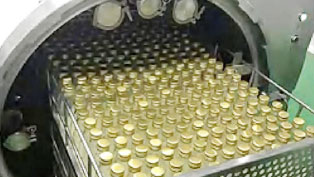
Bagged foods, glass jars, and metal cans differ in size, arrangement, and loading density. Even when using equipment of the same volume, the number of products that can be processed per batch may vary significantly.
When selecting a steam sterilization autoclave, verify the dimensions of the sterilization baskets, the arrangement of the packages, and the spacing between products to ensure that hot water or spray media can fully contact the product surfaces and to prevent improper loading from affecting heat distribution.
2. Temperature Control and Circulation System
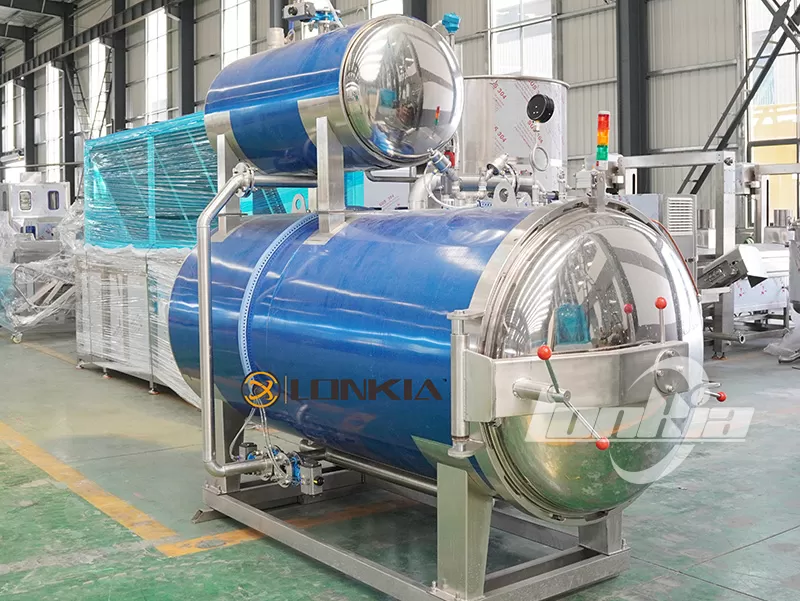
Equipment capacity must be balanced with sterilization effectiveness. LONKIA steam water spray sterilizers for bagged and canned foods utilize a combined water bath and full-spray design, employing a circulating medium to achieve relatively uniform heat distribution, with a temperature control range of 60–121°C.
When determining equipment configuration, it is also essential to verify temperature control capabilities, circulation system performance, and target sterilization process requirements; processing capacity should not be judged solely based on the maximum temperature the equipment can reach.
How to Align Equipment Capacity with Production Line Requirements?
If the retort needs to be connected to existing filling, sealing, or packaging equipment, the production cycle times of the preceding and subsequent processes must also be considered. If the steam autoclave's processing speed is too slow, it may lead to a backlog of products awaiting processing; similarly, improper loading and unloading arrangements can increase wait times between batches.
It is recommended to verify the following information in advance:
- Planned daily processing volume and weight per batch.
- Product types, package dimensions, and packaging materials.
- Target sterilization temperature, hold time, and cooling requirements.
- Planned operating duration and number of batches per day.
- Equipment installation space, steam supply, and supporting facilities.
What Information Should Be Provided Before Purchasing a Steam Autoclave?
To obtain a more accurate equipment selection plan and quotation, it is recommended to prepare the product names, unit weight, package dimensions, daily output, target batch capacity, and process requirements. If multiple types of packaging need to be processed, the specifications for each product type should also be provided separately.
LONKIA can further tailor equipment capacity, external dimensions, and related configurations based on the customer's actual production needs, helping food processing plants plan their sterilization processes effectively.
Selecting the right steam autoclave is not simply a matter of choosing the largest possible unit; rather, it depends on ensuring that the single-batch loading capacity, complete sterilization cycle, packaging compatibility, and production line cycle time are all well-matched. Clarifying these details before purchasing helps minimize selection errors and provides a reliable equipment foundation for stable production.