
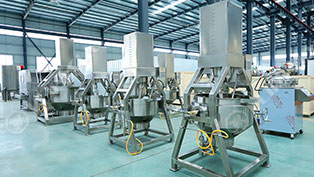

When selecting a steam jacketed kettle for food processing, many customers face a critical decision: should they include a stirring system? This decision not only affects equipment costs but also directly impacts production efficiency and product quality. This article will help you make a more informed choice from a practical, application-oriented perspective.
What Is a Steam Jacketed Kettle with Stirring?
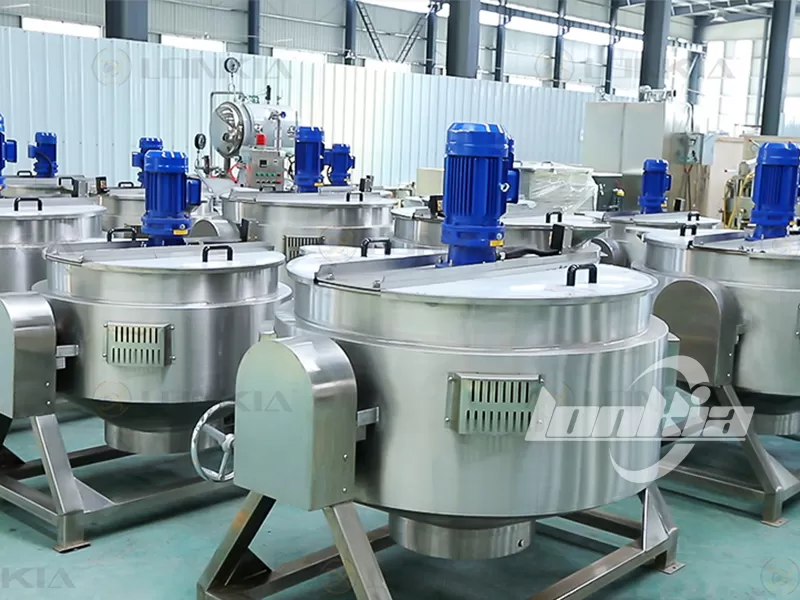
A steam jacketed kettle with stirring is a traditional steam-jacketed kettle equipped with a mechanical stirring device (such as scraper-type or paddle-type agitators). Its core structure consists of an inner pot, a steam jacket, and an agitation system.
The equipment circulates steam through the jacket to evenly transfer heat to the pot, while the agitation system continuously stirs the material, achieving a more uniform heating effect.
👉 In short:
Steam handles the heating, while agitation ensures uniformity and prevents scorching.
Why Are More and More Customers Choosing Models with Agitation Systems?
1. Preventing Burning and Clumping
While steam-jacketed kettles use indirect heating, there is still a risk of localized overheating for high-viscosity materials (such as jams, syrups, and sauces).
The agitation system continuously stirs and scrapes the sides of the vessel, effectively preventing materials from sticking to the bottom or clumping, thereby improving product consistency.
2. Improving Heating Uniformity
Standard jacketed kettles rely on natural convection, whereas models with stirring mechanisms create forced circulation, ensuring more uniform heat distribution and preventing localized overheating.
👉 Results:
- More uniform color
- More consistent texture
- Higher batch consistency
3. Increased Production Efficiency
Stirring accelerates heat transfer, thereby shortening heating time.
Additionally, automatic stirring reduces manual intervention, making production more continuous and stable—ideal for large-scale manufacturing.
4. Wider Range of Applications
Steam jacketed kettles with agitation can process a wider variety of materials, such as:
- High-viscosity sauces
- Candy mixtures
- Concentrated foods
- Dairy products
Compared to standard equipment, they offer significantly greater adaptability.
When Is Agitation Essential?
If your application falls under the following categories, we recommend selecting the agitated version:
✔ High-viscosity materials
Such as sauces, tomato paste, chili sauce, etc.
✔ High product quality requirements
For export products or branded products requiring consistent quality
✔ Continuous production needs
For long-term operation where manual stirring is impractical
👉 In these scenarios, models without stirring often lead to quality fluctuations or even the risk of product waste.
Are Non-stirring Models Completely Unusable?
Not necessarily. For the following situations, a standard steam jacket kettle may be considered:
- Liquids (soups, beverages)
- Low-viscosity materials
- Small-batch trial production
However, please note:
👉 Once material viscosity increases, issues will quickly arise (scorching, separation, uneven heating)
Cost vs. Return: Is it Worth the Investment?
Many customers are most concerned about whether the stirred version is too expensive.
In the short term:
✔ The cost is indeed higher
But in the long term:
✔ Reduced labor costs
✔ Lower scrap rates
✔ Improved product quality
✔ Increased production capacity
👉 In fact, most food processing companies eventually upgrade to a stirred kettle.
Advantages and Recommendations for Lonkia Steam Jacketed Kettles
Taking Lonkia's steam-jacketed kettles as an example, the equipment typically features:
- Food-grade stainless steel construction
- Automatic stirring system
- Precise temperature control design
- Tilting discharge mechanism
This not only effectively prevents scorching but also enhances overall production stability, making it suitable for complex processes such as sauces and syrups.
Conclusion
The answer is clear: in most cases, it's worth it.
If your production involves:
✔ Viscous materials
✔ High quality standards
✔ Continuous production
👉 Then a steam-jacketed kettle with stirring is practically a must-have.
Additionally, when selecting equipment, don't focus solely on price; instead, pay close attention to:
- Whether it features a scraping agitator
- Whether the stirring method is suitable for the material
- Whether temperature control is stable
- Whether discharge is convenient
If you're unsure whether your material requires stirring, let me know your product type, and our professional sales representatives can help you determine this directly and provide configuration recommendations.